
Introduction
Web development tools are the backbone of modern websites and web applications. If you are just starting your journey in web development or already have some experience, understanding web development tools will make your work faster, cleaner, and more professional. These tools help developers write code, design layouts, test performance, fix errors, and manage projects efficiently. Without the right tools, building a modern website can feel confusing and time-consuming.
Today, web development tools are used by freelancers, agencies, startups, and large companies. From simple code editors to advanced frameworks and testing platforms, these tools support every stage of the development process. Beginners use them to learn and practice, while intermediate developers rely on them to improve productivity and code quality. As technology evolves, new web development tools continue to appear, offering better speed, security, and collaboration options.
In this guide, you will learn what web development tools are, why they are important, and how to use them step by step. The article is written in simple English with clear examples, making it easy to understand even if you are new to the field. You will also discover the benefits, risks, common mistakes, expert tips, and answers to frequently asked questions. By the end, you will have a strong foundation to choose and use web development tools confidently in real-world projects.
What is Web Development Tools?
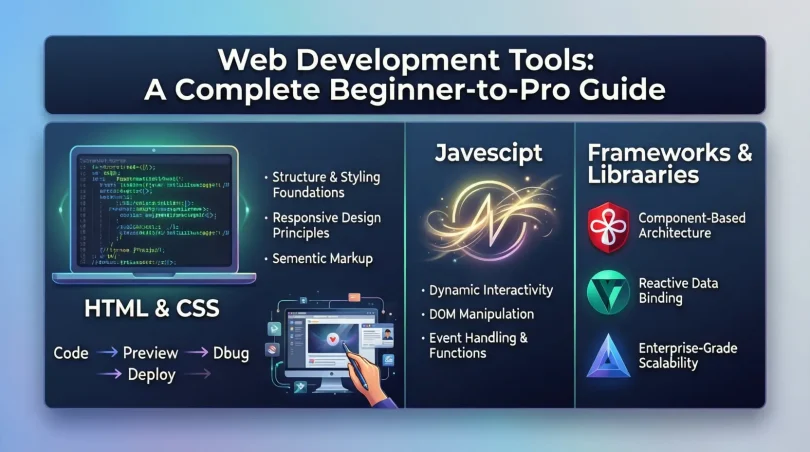
Web development tools are software applications and platforms that help developers create, design, test, and maintain websites and web applications. These tools support both front-end and back-end development tasks. Front-end tools focus on user interface and design, while back-end tools handle server logic, databases, and performance.
Web development tools include code editors, version control systems, frameworks, libraries, browsers, testing tools, and deployment platforms. Each tool has a specific purpose, but together they create a smooth development workflow. For example, a code editor helps you write clean code, while a browser developer tool helps you debug errors.
These tools are not only for professional developers. Students, hobbyists, and small business owners also use web development tools to build and manage websites. With the right combination, anyone can create a functional and attractive website.
Why is Web Development Tools Important?

Web development tools are important because they simplify complex tasks and save time. Writing code manually without tools increases errors and slows down progress. Tools automate repetitive tasks and provide real-time feedback.
Another reason web development tools matter is quality. They help developers follow best practices, improve performance, and ensure security. Testing tools find bugs early, while version control tools protect your work from loss.
Web development tools also support collaboration. Teams can work on the same project without conflicts. Changes are tracked, reviewed, and merged smoothly. This makes project management easier and more transparent.
Finally, web development tools support learning and growth. Beginners understand concepts faster, and intermediate developers refine their skills. In short, these tools are essential for building modern, reliable, and scalable websites.
Detailed Step-by-Step Guide
Step 1: Choose a Code Editor
A code editor is where you write and manage your code. It highlights syntax, suggests corrections, and organizes files. Beginners should choose a lightweight editor with helpful features.
Start by installing one editor and learning its shortcuts. This improves speed and reduces errors. Over time, you can customize it with extensions.
Step 2: Learn Browser Developer Tools
Every modern browser includes built-in developer tools. These tools inspect HTML, CSS, and JavaScript in real time. You can see how elements behave and fix layout issues instantly.
Use these tools to test responsiveness, check console errors, and analyze performance. They are essential for debugging.
Step 3: Use Version Control Systems
Version control systems track changes in your code. They allow you to revert to older versions if something breaks. This is very useful for learning and teamwork.
Create a repository and commit changes regularly. This habit protects your progress and builds discipline.
Step 4: Select Front-End Frameworks
Front-end frameworks help build user interfaces faster. They provide reusable components and structured workflows. This reduces repetitive coding.
Choose one framework and understand its basics. Avoid switching too often at the start.
Step 5: Choose Back-End Tools
Back-end tools manage server logic and databases. They handle user authentication, data storage, and application logic.
Start with one language and its ecosystem. Practice building small applications to understand how data flows.
Step 6: Use Package Managers
Package managers install and update libraries easily. They save time and manage dependencies automatically.
Learn basic commands and understand how packages work together in a project.
Step 7: Test Your Website
Testing tools check functionality, performance, and security. They identify bugs before users see them.
Test regularly during development, not only at the end. This improves quality.
Step 8: Deploy and Monitor
Deployment tools publish your website online. Monitoring tools track performance and errors after launch.
Learn basic deployment steps and keep monitoring active to fix issues quickly.
Benefits of Web Development Tools
- Improve development speed and efficiency
- Reduce coding errors and bugs
- Support clean and organized code
- Enable collaboration and teamwork
- Improve website performance and security
- Help beginners learn faster
- Support scalable and maintainable projects
Disadvantages / Risks
- Learning curve for beginners
- Tool overload can cause confusion
- Dependency on tools may reduce core skills
- Compatibility issues between tools
- Frequent updates require maintenance
Common Mistakes to Avoid
One common mistake is using too many tools at once. This creates confusion and slows learning. Start simple and add tools gradually.
Another mistake is ignoring documentation. Many developers struggle because they skip official guides.
Not using version control is also risky. Losing work can be frustrating and demotivating.
Finally, avoid copying configurations blindly. Understand what each setting does before applying it.
FAQs
What are the most important web development tools for beginners?
Beginners should start with a code editor, browser developer tools, and version control. These cover basic needs.
Do I need to learn all web development tools?
No, focus on tools that match your goals. Learn gradually as projects grow.
Are web development tools free?
Many tools are free or open source. Paid tools usually offer advanced features.
How often should I update my tools?
Update regularly, but avoid updating during critical projects. Test updates first.
Can web development tools replace coding skills?
No, tools support coding skills but cannot replace understanding fundamentals.
How do I choose the right tools?
Consider project size, skill level, and community support. Simplicity is key.
Expert Tips & Bonus Points
Always master fundamentals before relying on tools. This builds confidence and flexibility.
Keep your toolset minimal and well-understood. Quality matters more than quantity.
Follow communities and updates to stay informed. Learning never stops in web development.
Practice by building real projects. Tools make sense when used in real situations.
Conclusion
Web development tools play a vital role in creating modern websites and applications. They simplify tasks, improve quality, and save valuable time. For beginners, these tools provide structure and guidance, making learning less overwhelming. For intermediate developers, they enhance productivity and support complex projects.
By understanding what web development tools are and how to use them step by step, you gain confidence and control over your work. Choosing the right tools, avoiding common mistakes, and following expert tips can significantly improve your development journey. Remember that tools are helpers, not replacements for skills. Strong fundamentals combined with the right tools create powerful results.
As technology continues to evolve, web development tools will also change. Stay curious, keep learning, and adapt gradually. With a balanced approach, you can build secure, fast, and user-friendly websites that meet modern standards. Mastering web development tools is not about knowing everything, but about using the right tools wisely and effectively.